Thursday

Alexander, J B - portrait of James Hogg

This miniature portrait is interesting as it illustrates the progression of how a particular pose of a sitter may be reused as the subject for a miniature. However, there is also a puzzle connected with it.

The miniature is housed in what appears to be a miniature case from the 19C. It seems to be made of what looks like 14c gold, with a hinged hanger at the top and a full window on the reverse which covers some dark fabric.

It is clearly signed inside "Miniature of James Hogg, Poet, by JB Alexander, 1911". Additionally, there is a printed label between the fabric and glass on the reverse, which reads the same, although without the date.

The puzzle associated with the miniature is that the only recorded artist with the name J B Alexander worked in the United States in Charleston in the period 1830-1840.

A miniature by this other J B Alexander is included in the American 1 Gallery of this collection and recent research has determined he was born in 1812, thus he is unlikely to be the artist for this miniature dated 1911. Therefore, although this miniature has been included in the American section of this collection, there is the possibility the miniature is actually by a previously unrecorded British artist.

It is also odd to have a printed label inside a miniature case, identifying both the artist and the sitter.

The label gives rise to speculation that this J B Alexander may have painted, for commercial reasons, a number of versions of the miniature to commemorate some anniversary or event connected to James Hogg. It is conceded the ability of the artist seems to be limited, which perhaps supports the concept of a miniature painted for commercial reasons.

Turning to the sitter. James Hogg (1770-1835) was a Scottish poet and author. He had little formal education, which makes the range and quality of his literary output all the more surprising. Born on a farm at Ettrick, he had ambitions to be a writer from an early age and came to believe that he might emulate Burns. He was still working as a shepherd when his first, unsuccessful, volume of poems appeared in 1801. The following year he met Scott who would champion him over many years.

Hogg's appearance on the literary scene was established by The Queen's Wake which came out in 1813. Many times reprinted, it contains his most quoted piece of verse, 'Kilmeny'. Thereafter his work ranged from the brilliant parodies of contemporary poets in The Poetic Mirror to the works in prose: The Brownie of Bodsbeck, The Three Perils of Man, and, most remarkable of all, The Memoirs and Confessions of a Justified Sinner, which introduced the theme of the evil doppelganger into Scottish literature. For much more about James Hogg, see James Hogg Society

In 1830 a large oil portrait of him was painted by Sir John Watson Gordon. It is shown here just for comparative reference and the original hangs in the Scottish National Portrait Gallery.

It is evident from the example shown here, that the oil portrait was the source of a 19C engraving of James Hogg.

This print was engraved by George J Stodart in 1876. In turn it seems the miniature was copied from the engraving.

James Hogg is buried in Ettrick Churchyard, Ettrick, Scottish Borders.

Since writing the above, I am grateful for the following helpful comments received from the James Hogg Society.

"I'm sure you are right in thinking that it derives ultimately from the Watson Gordon oil-painting of around 1830. This was painted for the Edinburgh publisher Robert Cadell, but subsequently sold to the Blackwood firm and hung in their salon at 45 George Street in Edinburgh for many years until acquired by the Scottish National Portrait Gallery in Queen Street, Edinburgh.

The Watson Gordon portrait was engraved almost as soon as painted and an engraving published as a preface to the fourth volume of the 'Edinburgh Literary Journal'. A notice 'To Our Readers' in the advertising material to the issue for 26 June 1830 (p. 63) says the portrait was first published with 'the July part' of this weekly literary paper. Hogg himself requested extra copies, presumably to give away to his many visitors at Altrive in Yarrow. The portrait is also referred to in Lockhart's 'Life of Sir Walter Scott, Bart.', 7 vols (Edinburgh, 1837-38), VII, 276 as a 'perfect' likeness. One way and another, it was probably the best-known portrait of Hogg in the nineteenth-century and an obvious choice for a later copyist.

I don't know anything about the artist, and the only Hogg associations I have with the year 1911 is that (if I remember rightly) Hogg's grandson Robert Gilkison and his wife were in Scotland around then." 1262

Tuesday

Russell, Moses B - portrait of a young lady


This is an important miniature by Moses B Russell (1810-1884). It has an incised script signature on the right "M B Russell Pinxit" and on the reverse is also signed "Painted by M B Russell Boston 1835 (or 1836)".

It is unusual to be signed on the front and the rear, with both appearing to be genuine. The signature being incised through to the ivory base, is probably due to the artist recognising that a painted signature would not be legible on the dark background. It is also unusual to find a miniature by him at this time of a lady.

In terms of quality, it must rank as one of his very best miniatures. As with other work by him of this time, it depicts the sitter as solemn, but concentrating upon the artist in a manner that would become very familiar as photography later developed.

Russell was active for over 50 years both as a painter and as a daguerreotypist, mostly in Boston, although he did work in New York and Philadelphia in the years 1854-1861.

Johnson observes that Russell performed his best work in the ten years from 1834. It seems likely his later work was hurried in comparison, hence suffering in quality, due to the impact of photography and the need to complete miniatures quickly, to compete with the lower cost daguerreotypes which became popular after 1840.

That probably also explains the need for him to seek work in New York and Philadelphia, there not being enough in Boston. However, while in Philadelphia he would have found it difficult to compete with John Henry Brown who persevered with miniatures of the highest quality in the face of photography.

Some of Russell's later miniatures, show the influence of his wife, Clarissa Peters Russell, who is famous for her distinctive miniatures, particularly of children. It may be that he found her style quicker to produce and easier to sell against daguerreotype competition. That is a pity, as this miniature shows he was very talented, with such talent not being so obvious later in his career.


The case of this miniature is ornately carved and does not appear to be original, although still of 19C origin, perhaps it is German. Unfortunately, the sitter is unknown. 1257

 This is one of over a dozen American portraits in the collection, from around 1830-35, all depicting young ladies wearing a "little black dress", and thus indicating the 19C origin of the proverbial fashion item, of  a "little black dress" usually claimed as being in the 1920's.

Sully, Lawrence - portrait of a Southern Lady


This miniature was acquired as a single lot, together with the adjacent portrait which is currently tentatively attributed to Thomas Sully.


The two miniatures were acquired at a public auction in Columbia, SC where they were described as "Continental school (late 19th century)" with the stated provenance "Property from the estate of a Southern lady".


The auction description was incorrect for this miniature, as the portrait is considered to have been painted in America at some date from around 1795-1800.


The case is well made and believed to be American made, in a manner which evolved from a style previously developed in Ireland.


This has hair under glass on the rear of the case, but with the rear glass only covering part of the reverse. In contrast most British miniatures with rear glass had the glass covering most of the reverse of the case.


Although possibly by an unknown artist, this miniature has been attributed in the interim to Lawrence Sully (1769-1804) who emigrated from Ireland to the United States in 1792 with his actor parents.


He had already trained as a miniature painter at the Royal Academy in London before he arrived in Charleston in 1792.

Sully worked in the area until he moved to Norfolk in 1801, and then Richmond until his death in 1804. Thus these locations fit with the provenance of an estate in Columbia SC.

The pose of this sitter is the same as three miniatures by Sully which are illustrated as figs 230-232 in Johnson. One of these, fig 232 of a girl, is shown here in black and white.


Also shown for comparison is another miniature of a man, they are both signed Sully, although he did not always sign his work.


Being unsigned, and given the hair style of the sitter, it seems the miniature of the lady would need to be one of Lawrence Sully's early works, painted around 1795.

Johnson comments "Lawrence Sully's miniatures rarely rise above the level of the primitive. The treatment is linear, with little facial modelling and stiff, somewhat awkward body forms. Pale skin tones and light-colored backgrounds make for a blond tonality overall." (The background of this miniature is paler than appears in these images.)

However, a kind visitor has some doubts about the attribution to Lawrence Sully and so until there is clearer evidence one way or the other, the attribution is unconfirmed.

An anonymous visitor has questioned the brightness of the background. That was my fault. I have since tried to modify the image to make it closer to the original. However, even now the image is still too violet, the actual miniature having a pale sky blue background.

Although not attributed there to Lawrence Sully, two miniatures which are possibly by him can be seen at A Portion of the People: Three Hundred Years of Southern Jewish ... One being of Sarah Moses Levy and one of Chapman Levy. 1251a

Sully, Thomas - portrait of a young lady


This miniature was acquired as a single lot, together with the adjacent portrait now attributed to Lawrence Sully. As noted there the two miniatures were acquired at a public auction in Columbia, SC where they were described as "Continental school (late 19th century)" with the stated provenance "Property from the estate of a Southern lady". The auction description was also wrong for this miniature, as this one is American from around 1795-1810, the frame being distinctively American, although the hanger is now missing, as is the central insert on the rear. The frame has a somewhat crude, hand-made appearance, and imitates a style previously developed in Ireland.

This miniature is also unsigned, but it has been attributed to Lawrence's younger brother, Thomas Sully (1783-1872), however it is possible it is also by Lawrence Sully. Thomas Sully was introduced to miniature painting by his school friend Charles Fraser. They both became very famous artists of 19C America. Sully also trained with his brother in Charleston SC in 1799 before moving to Virginia. Thus Columbia fits with Thomas Sully's general area of work around 1800, until 1806 when he moved to north to New York and later Philadelphia. He then went to London in 1809 and returned in 1810.

Few miniatures by Thomas Sully are available for comparison. However, one good example can be seen at Kenmore Collections - Maria Carter Tucker This one of Maria Tucker painted in 1805, has a very similar tilt to the subject's head, similar mouth and eyes, and also the way her hair is shown on her neck. It is also markedly sentimental in style.

In commenting on the early work of Thomas Sully, Johnson noted "These early miniatures show fine attention to detail... Study in England transformed Sully's characteristic portraits to flattering, dashing, romantic likenesses, often bordering on sentimentality."

Those comments fit this miniature. 1251b

Sunday

Rogers, Nathaniel - portrait of a young man


This miniature portrait was acquired as a pair, together with the accompanying portrait which is either by Samuel P Howes (1806-1881) or Mrs Moses B Russell (1809-1854). At the time of acquisition the miniatures were both unattributed.

Both miniatures were joined in a cheap modern frame when acquired, which detracted from their appearance and no doubt contributed to the artists not being recognised by the vendor. At first glance it seems they are husband and wife as the two frames are joined by two metal hinges. However, it seems more likely that both miniatures were removed from period frames in the 1970's.

However, this one has been attributed, fairly confidently, to Nathaniel Rogers (1787-1844) who mainly worked in New York and was one of New York's leading miniaturists in the early 19C.

Rogers worked in New York and died in 1844, whereas Howes and Mrs Russell both worked in Massachusetts. The dress worn by the young lady, dating from around 1850, is probably twenty years later than the clothing of the young man which is from around 1830. Their acquisition in Philadelphia, rather than New York or Boston, is perhaps a reason for the vendor not recognising either of the artists.

Johnson comments on Rogers' work, "Rogers employed a palette of clear, lively color. His work of around 1815 was already delicate and sophisticated. The subjects of his highly individualized portraits are presented in a direct and appealing manner."

"Rogers used an oval format until about 1825, when he began to favor a rectangular one. He painted faces with a gentle stipple, often modelling the shadows in tones of red and emphasizing the eyes. When representing women he tended to make the heads disproportionately large and the bodies small. Details of dresses are sharply defined with gum arabic."

In fact this portrait looks so much like a Rogers, it appears as if it has "escaped" from colour plate 15 of the Manney Collection catalogue!

This young man is sitting in the same pose and on the same chair as the older man there, the sky is similar to that for both the older and younger lady, and the left hand edge of the window opening is very similar.

Rogers has painted the face of this young man showing a well-fed and slightly self satisfied expression, with rosy cheeks.


Within this collection there are three other miniatures by Rogers, all are oval in shape. One is of David Ryerson and another is of a Master Bucknell. Expert opinion has advised that one of a man with a mustard colored background as shown here, is also by Nathaniel Rogers.

The sitter in this portrait is unknown. 1238

Howes, Samuel P - portrait of a young lady

This miniature portrait was acquired as a pair, together with the accompanying portrait by Nathaniel Rogers. At that time they were both unattributed.

An attribution for the artist who painted this miniature is not as certain as for the Rogers, but one possible artist is Mrs Moses B Russell, also known as Clarissa Peters Russell. However, it could be a later work by her husband Moses B Russell, after he had been influenced by her style.

A kind visitor to the collection has since suggested a third possible artist for this miniature is Samuel P Howes (1806-1881) who resided in Lowell, Massachsetts, primarily painting large oil portraits, but also some miniatures. This suggestion focuses particularly on the cross-hatched background and the shape of the mouth, but also the clothes, necklace, and hair.

Miniatures by Samuel P Howes are rare and hence, there were very few published examples to make a comparison with. However, there is a 1986 exhibition catalogue of his larger portraits on oil which does include one miniature by him. It is difficult to generalise, when comparing miniatures and large oils, but in his work of around 1845, there are several examples showing large draperies painted in a similar manner to this miniature. The 1986 catalogue also contains the following comments on his style, which were written by Paul D'Ambrosio. As the catalogue is very hard to obtain, the comments are repeated in detail below.

"Howes rendering of anatomical features is distinct. His sitter's faces are particularly recognisable as the product of his hand. They are invariably shown in a three-quarter view with an awkwardly turned nose and thick, full cupid's bow lips. All but a few of his first known sitters have elliptical irises. Young children are sometimes depicted with chubby, rounded cheeks. In all of the portraits, the shading of the face and neck is convincingly rendered, giving the sitters a naturalistic appearance."

"Many of the adult sitters have one hand draped over the arm of a chair or sofa, slanting diagonally downward. Often the hand is marked by a pointed thiumb and the slightly extended position of the index and middle fingers. Howes adult sitters of the late 1830's and 1840's also have attenuated arms that, in the male portraits, have a rubbery bend at the elbows. Some of the women's portraits of this time have slim stylized torsos."

"Howes female sitters are frequently adorned with a variety of jewelry including earrings, necklaces, brooches, and rings. There are a variety of background treatments that characterize Howes' work. Drapery, typically a rich red shaded in black, begins to appear in 1839 and is handled in a number of ways. ..... An array of objects used as props can be seen in the various portraits, the most common of which is a book." At this point the attribution to Howes seems the most likely.

Both this and the miniature by Rogers were housed together in a very cheap and combined modern frame from around 1990, which detracted from their appearance and no doubt contributed to the artists not being recognised by the vendor.

Although this portrait is no longer attributed to Mrs Moses B Russell, some comments on her work are relevant as it does have some similarities with her work. In Johnson's book about the Manney Collection figs 209 and 210 are actually by her and not by her husband, as attributed in the book. Both those young ladies are sitting holding a book in a similar pose.

The following comments from Johnson are also relevant "Details of dress and interior furnishings are very decorative, incorporating a variety of patterns. Flowers or vines are often introduced at the edges of the composition. Pale skin tones contrast with deep shades of fabrics, against striated backgrounds..."
Here the young lady is sitting on a decorative sofa and flowers can be seen outside the window. Although difficult to see, there is a great deal of detail on her dress, including a lace bodice right across her chest and lace cuffs on her dress.

This is the only American miniature in the collection that has a rare crystalline growth over parts of the miniature. It can best be seen as a lace like effect on her neck. The sitter is unknown. 1239.

This is one of over a dozen American portraits in the collection, from around 1830-35, all depicting young ladies wearing a "little black dress", and thus indicating the 19C origin of the proverbial fashion item, of  a "little black dress" usually claimed as being in the 1920's. 

Fraser, Charles - portrait of a lady

This miniature portrait was acquired without any attribution, although the vendor did say that the estate it was purchased from, had thought the sitter was from either North Carolina or South Carolina.

Unfortunately, the vendor could not disclose the family name of the estate. The backing paper seems as if it may have been replaced and this may be why the reverse has no signature.

However, from a comparison of the portrait with examples illustrated in the Carolina Art Association Catalogue prepared by Martha Severens, it is believed the miniature is possibly a late work by the Charleston, SC artist, Charles Fraser (1782-1860) or if not, is likely to be a copy of a miniature by him.

It is known that Henry Bounetheau (1797-1877) also of Charleston, SC did frequently copy Fraser's miniatures.

Martha Severens makes the following comment on page 70 of the CAA catalogue, about an 1842 work by Fraser: "Typical of Fraser's later work, (the sitter's) portrait has somber coloring, harsh stippling and a rigid pose. The fact that the stippling around the body aand the head, in particular, is accentuated contributes to a disconcerting halo effect."

Apart from a general comparison of style, the following are the key reasons for attributing any original of this portrait to Fraser.

Firstly, the background close to the head has many fine lines outlining the head. Severens uses the term "halo", but in some instances of Fraser's work, the lines are so pronounced that it almost looks as if a sitter has a "bird's nest" on their head.

Secondly, the size of 80 mm x 108 mm falls right in the range of sizes of rectangular miniatures painted by Fraser.

Thirdly, the pose is very similar to several miniatures by Fraser illustrated in the CAA catalogue, especially the 1840 portrait of Mrs William Mayrant (67.31.1) and the 1848 portrait of Mrs William John Grayson (40.7.1)

Martha Severens also comments:

"The format of Mrs Myrant's portrait [by Fraser] is reminiscent of a type used by Samuel F B Morse for older women. The white bonnet and shawl serve to set off the face, while the red chair adds a comfortable feeling of warmth".

Severens makes a similar comment about the Grayson portrait.

An image of the case is also shown here. It is leather, decorated with a flower pattern, and is 120 mm x 152 mm in size.

Unfortunately, the sitter is unknown. 1240

Saturday

Alexander, J B - portrait of two children

This miniature portrait is signed J B Alexander. Reference books say little about him other than that a J B Alexander was active in Charleston between 1830 and 1840.

However, a J B Alexander (1812->1880) has now been located in the 1850 census for Camden, Kershaw, SC, where he gave his age as 38, his occupation as artist, his assets as $2000, and his place of birth as South Carolina. He was living with his wife E A (E M?) Alexander aged 36 and several children; Ann Alexander 15, Jas (?) Alexander 12, A A Alexander 10, G G Alexander 5, and J H Alexander 2 who were all born in SC. A teacher from Canada called I P Lee also lived with the family.

He was still there for the 1860 census, but now described himself as a silversmith, his assets as $14,600 and they had two more children M M Alexander 10, and W S Alexander 6 mths. There was also a S Norton (Horton?) aged 75 living with them, perhaps his mother-in-law. He presumably changed his occupation due to the lack of painting commissions, after the advent of photgraphy, but must have been successful as a silversmith for his assets to increase so much in ten years.

In the 1880 census he still lived in Camden, although now a widower, and with the occupation of jeweller. His son Geo C Alexander, a newspaper publisher, lived with him. They family has not yet been located in the 1870 census, although it seems likely that George was the George Alexander from SC who was working as a printer in NY in 1870. His age was given as 20, but all ages in that census return are rounded to the nearest ten years.

The sitters in the miniature are unknown, but it is even possible his children modelled for this miniature. 948

Ames, Daniel - portrait of a lady


This miniature portrait is signed "? Ames 1851". Unfortunately, the first initial is hard to read, but presumably it is Daniel F Ames (1815-?) who was active in New York from 1837 to 1858, and the only member of the family whose dates fit.

In the 1850 census, Daniel F Ames aged 35 lived with his wife, Ann aged 34 and five children aged 5 to 17, in the 20th Ward of Brooklyn, New York. He gave his place of birth as New York and occupation as painter. He must have married at age 18 and moved about as two of his children were born in New Jersey

The sitter is unknown. 1054

Barratt, Thomas E - portrait of Joshua Elder


This miniature portrait is unsigned, but has been attributed to Thomas E Barratt (1811-?) who was active in Philadephia (1833-1854). In the 1850 census he was living in Dock Ward, Philadelphia, aged 39, gave his occupation as Miniature Painter, and was living with his wife Elizabeth B Barratt and daughter also named Elizabeth. All three were born in England. Living with them were Edward Williams a Performer, and Manual Eyre an Agent, but it is not known what type of performer Williams was. There was also a servant, so Barratt must have been a successful artist at this stage.

The case is engraved on the reverse "Presented to Mrs E S Elder by Joshua Elder". Joshua Elder married Eleanor Sherer (1802-1837) on Mar 12, 1826. See Joshua Elder & Eleanor W Sherer

Both Eleanor and Joshua are buried in Paxtang and it seems likely Joshua was related to the the Joshua Elder who was Pastor of the Presbyterian Church and a slave owner, see Joshua Elder Slave Advertisement where there is this advertisement;


This miniature is illustrated in Wehle, plate XXXV and is also referred in Schidlof, but in both places the sitter is mistakenly referred to as Josiah Elder. Unfortunately, since the photograph was taken for the plate in Wehle, a vertical crack has appeared. 892

Berger, Charles F - portrait of a man


This miniature is signed on the reverse by C F Berger and dated 1842. Charles F Berger was active in Philadelphia between 1841 and 1880.

It seems likely he is the Charles F Berger listed in the 1860 census for Ward 14 in Philadelphia. Here he stated he was an artist, aged 49 and born in Hamburg. He disclosed real estate assets of $4000 and personal assets of $800 and was living with his wife Mary aged 37 and four children, Anna J 18, Mary E 16, Charles T 14, and Clara A 11. As his wife and children were all born in Pennsylvania, he must have arrived in the United States not later than around 1840.

In the 1850 census, he had stated he was a painter but gave an age of 37, so he must have been born around 1812. There was a servant living with the family in 1850, but not in 1860, which is perhaps a sign that the advent of photography had impacted on his income.

In the 1870 census, the enumerator did not complete the personal particulars for Charles, Mary, and Clara, but they did still seem to be living in their own home. However, by the 1880 census, Charles 69, Mary 60, and Clara 30, were living together as boarders in a boarding house with a number of other families. Charles gave his occupation as portrait artist, but it seems the family was even less well off.

The sitter is unknown. 486

Blood, M I - portrait of a girl


This miniature portrait is signed "M I Blood", but no record of the artist has been found. Judging by the design of the case, it may be South American. The sitter is unknown. 974.

 This is one of over a dozen American portraits in the collection, from around 1830-35, all depicting young ladies wearing a "little black dress", and thus indicating the 19C origin of the proverbial fashion item, of  a "little black dress" usually claimed as being in the 1920's.

Boudon, David - portrait of a man


This miniature portrait in silverpoint is inscribed on the reverse, but it is difficult to read. It looks like "David Boudon Fecit aber 08 86". The two words David Boudon are quite clear and the signature matches figs. 178 and 179 in "100 Ans de Miniatures Suisses". David Boudon (1750-1816?) was born in Switerland, but emigrated to America and worked in Philadelphia.
There are detailed articles about him in "100 Ans De Miniatures Suisses" pp139-146 and "Wintatur Portfolio 9" pp77-101.
The sitter is unknown. 646a

Boudon, David - portrait of a lady

This miniature portrait in silverpoint is signed on the reverse. However, paper has been stuck to it and it is illegible. Nevertheless, it is possible to confirm the word "aber" in the same handwriting as on the reverse of the adjacent miniature by Boudon. The sitter is unknown. 646b

Brown, Abby Mason -portrait of a lady


This miniature portrait is signed "A Brown", possibly for Abby Mason Brown, who was active in New England (1800-1822). The case is not original. The sitter is unknown. 351

Brown, Henry I - portrait of a man


This miniature portrait is signed "H Brown" for Henry I Brown (1822->1880) who is recorded as active in Boston (1844-1851). The sitter is unknown. It is thought that, as Brown tended to use thickly applied paint, that he also painted oil portraits.

His self described occupation of painter in the 1850 census as shown below, supports this view. Although by the 1880 census, he describes himself as house painter. Thus it seems likely that as the daguerreotype tended to displace miniature painting around 1850 and none of his works are known dated after 1851, he turned to house painting to support his family. Nevertheless, as he lived in Salem for over thirty years, it seems likely he painted many large oil portraits over that period.

It seems fairly certain he is the Henry Brown 3rd listed in the 1850 census for Salem Ward 1 in Essex, Ma. There he was living as a lodger with his wife Mary E Brown and gave his occupation as painter, his age as 29 and his place of birth as England.

In the 1860 census he still lived in Salem with Mary and gave his occupation as painter, although now he described himself as Henry Brown Jr and his age as 37. Inthe 1870 census he is again in Salem with Mary and three children, Henrietta, Minnie, and Henry. His occupation is described as "works painting" and his age is 45. In the 1880 census he gives his age as 58 and his occupation as house painter. He must have died before 1900, as his wife Mary E Brown appears to be living in Salem as a widow in the 1900 census. 899

Brown, John Henry - portrait of Mrs Antoinette Wilmer


Painted in 1852 is this miniature portrait signed on the reverse "Copied from a daguerreotype J Henry Brown pinxit Phil 1852". John Henry Brown (1818-1891) was active as miniature painter in Philadelphia for a number of years. He was highly thought of and won a medal at the 1876 exhibition. He was one of very few miniaturists who were able to compete with the new art of photography.


Brown charged $125 to paint this portrait, which was a lot of money at the time and equivalent to around $5000 today. This and the following group of miniatures show a good cross-section of his work.
There is an excellent article about John Henry Brown by Anne Verplanck, in The Magazine Antiques for November 2004 see Magazine Antiques: The art of John Henry Brown
 

The sitter is Antoinette Tessieire Wilmer and was identified from a note on the reverse where she is described as "Mrs Ringold Wilmer - mother's sister - sister of Mrs James C Fisher". Research has identified Antoinette Tessieire (1817-c1852) who married John Ringgold Wilmer (1813-1886) on Nov 9, 1847. In the 1850 census John Ringgold Wilmer was aged 32 and described himself as a merchant. Antoinette is recorded as aged 23 and is seems likely she died in childbirth a year or two later. John Ringgold Wilmer was married for a second time in May 1855 to Marie Jeanne Nathalie de Chazournes (1827-?). 


Given the date of 1852 on the reverse of the miniature, it appears that the miniature was painted from a daguerreotype shortly after Antoinette's death, possibly at the request of her mother, Eliza Tesseire. Verplanck mentions a similar instance regarding a portrait of Mrs Henry Fisher (this Fisher family appears to be unrelated to the Mrs James C Fisher referred to here). 


The wife of James Cowles Fisher was Mary Tessieire (Mary Tesseire) who he married 29 Apr 1847. She was another daughter of the Eliza Tessieire in the adjacent miniature and this explains the reference to "mother's sister". James was the grandson of the James Cowles Fisher who married the Nancy Wharton (aka Ann Wharton) who is the sitter in the miniature by Edward Heaton which appears elsewhere in this section. 


On the rear of the frame, there is a framemaker's label which reads "G Sauter, Manufacturer of Looking Glasses, Picture Frames & Passe-partouts, Also, dealer in Paintings, Engravings, Chromos. and other works of art. 138 South Eighth Street Philadelphia". The identical framemaker's label appears on the reverse of the miniature portrait in this Gallery by George Lethbridge Saunders. In the 1860 census George Sauter (1837-?) was living in Philadelphia with his parents, Charles F Sauter, who seems to have had a furniture store, and Caroline Sauter. George gave his occupation as "manufacturer of P Partouts". A passe-partouts is a mounting for a picture in which strips of gummed paper bind together the glass, the picture, and the backing, for insertion in the frame. The business must have been quite profitable in 1860 as George disclosed assets of $4000. By 1870 he was married to Christina Sauter and they had a daughter Mary Sauter, aged 2, but by 1880 he was living only with his mother, and even later in 1900 he was living as a lodger and his occupation was art dealer. 1100

Later, a kind visitor advises;
1- The portrait miniature of 'Mrs Geo W Morgan - Grandmother
Tessiere's mother' is of Hester Leib, wife of George Washington
Morgan. George Washington Morgan was born in 1776; he was the son of
Gen Jacob Morgan of the American Revolution. The Morgans were
merchants and heavily involved in shipping and the West Indies (sugar)
trade. George Washington Morgan and Hester Leib had 4 surviving
children: Eliza Caroline (m.Anthony Teisseire), Mary (m.Saturnius
Destouet), Harriet Adelaide (m.Thomas Ashton Morgan), and George Leib
Morgan (m.Lucretia Elizabeth Hamersley).

2- The Destouet family ('portrait of Mary Morgan Destouet').
Saturnius Destouet and his two brothers, Bartholomew & John E, were
merchants in Philadelphia under the name 'Destouet Brothers'. Bartholomew may have
died or returned to France by the late 1820s; only Saturnius and John
E show up in the later records. Their father's name was John; there
were also two sisters, Adele and Zelie, born about 1802 and 1807
respectively.
The father, John, along with Adele and Zelie, left the United States
in 1831 to travel in Europe; I haven't found any record of their
return to the US. Eliza Caroline Destouet, daughter of Saturnius & Mary
(Morgan) Destouet, married her 1st cousin, Thomas Hamersley Morgan,
son of George Leib & Lucretia Elizabeth (Hamersley) Morgan. The Rev Brockholst
Morgan who married them was Thomas' brother.

3- The wives of John Ringgold Wilmer ('portrait of Antoinette
Teisseire') were cousins. JRW's first wife was the daughter of
Anthony and Eliza Caroline (Morgan) Teisseire. JRW's second wife, Marie Jeanne Nathalie
de Chazournes, was the daughter of Felix and Marie Louise (Brugiere)
Chazournes. Marie Louise (Brugiere) Chazournes was the daughter of Charles and
Marie Antoinette (Teisseire) Brugiere. Marie Antoinette (Teisseire)
Brugiere was the sister of Anthony Teisseire.

Charles Brugiere originally worked for the firm 'Tarascon Brothers,
James Berthoud & Co'. They were Philadelphia merchants who later
established the town of Shippingport, Kentucky. After the Teisseire family's
arrival in Philadelphia in about 1800, Charles Brugiere and Anthony
Teisseire established the firm of Brugiere and Teisseire.

In about 1843, Charles and Marie Antoinette (Teisseire) Brugiere's
son, William, married Mary Morgan, daughter of Thomas Ashton and
Harriet Adelaide (Morgan) Morgan, thus completing the circle of Morgan,
Teisseire, and Brugiere.

One additional note - Thomas Ashton Morgan and his wife, Harriet
Adelaide Morgan were also cousins. Thomas' father, Benjamin, was a
brother of Gen Jacob Morgan. Gen Jacob Morgan was Harriet Adelaide's grandfather.

Brown, John Henry - portrait of Mrs Eliza Tessieire


Painted in 1858 is this miniature portrait, signed "J Hy Brown 1858" for John Henry Brown.  

The sitter has been identified, with kind assistance from the Rosenbach Museum and Library, as Mrs Eliza Tessieire. John Henry Brown charged $180 to paint this portrait. Eliza Caroline Morgan married Anthony Tessieire on March 19, 1813 in Philadelphia. 

See also; 

John Henry Brown | Smithsonian American Art Museum

Eliza's mother, Mrs Geo. W Morgan is the sitter in a miniature by George Lethbridge Saunders elsewhere in this American 1 gallery. Based upon the census information in the attached comments, Eliza was born in 1798 and thus only 15 when she married, and 60 when this miniature was painted. She was widowed before 1850, but by 1870 she had a personal fortune of $200,000, equivalent to around $10,000,000 today! 

Little is known about the Tessieire family, although on page 159 of "Salons Colonial and Republican", Anne Hollingsworth Wharton observes that a large number of the leading citizens of Saint Domingo immigrated to America when they were driven hither by the uprising in the island. These immigrants included the Tessieire (Tesseire) family and presumably Anthony was one of these. Although no relevant reference has yet been found, the Tessieire family presumably had also been slave owners in St. Domingo, and emigrated (or fled?) to the United States around 1804, i.e. after the Haiti Massacre. 

The most significant slave uprising in Saint-Domingue (now Haiti) was the Haitian Revolution (1791-1804), a successful revolt against French rule that created the first free black republic. The 1791 rebellion, sparked by the French Revolution's ideals and led by figures like Toussaint Louverture, grew from localized unrest into a full-scale war for independence, ultimately succeeding where others failed.

Saint Domingo Massacre of 1804

The 1804 Haiti massacre was carried out by Haitian rebel soldiers, mostly former slaves, under orders from Jean-Jacques Dessalines against much of the remaining European population in Haiti, which mainly included French Colonists. The Haitian Revolution defeated the French army in November 1803 and the Haitian Declaration of Independence happened on 1 January 1804.

The name Teisseire is still a well-known French manufacturer of non-alcoholic flavored syrups, established in 1720. They produce a wide range of fruit and plant-based syrups (e.g., passion fruit, mango, mint, etc.), including a non-alcoholic rum flavor syrup, but none of the current product lines or historical products are named "Saint Domingo". However, given the similarity of name and the sugar based product. it seems likely that an earlier generation of the Teisserie family was sent to Saint Domingo to manage a sugar plantation or to purchase sugar syrup, for shipment back to France. 

The Saint Domingo export business likely continued after the family left Haiti, and some profits from that and related activities, presumably still flowed to Eliza Tessierie in America, and explain why in 1870 she had assets of $200,000. The company was founded in Grenoble by Mathieu Teisseire in 1720. The Teisseire district in the city is named after the family. A distiller by trade, Teisseire originally manufactured vinegars and Ratafia de Teisseire, a type of cherry liqueur which he had invented and which made his family's fortune. The 18th-century Venetian adventurer Giacomo Casanova was particularly fond of Teisseire's ratafia and described it in his memoirs, Histoire de ma vie, as "the divine liqueur of Grenoble".He went on to write: "This excellent liqueur is composed of cherry juice, eau de vie, sugar, and cinnamon, and it would be impossible for the nectar of the gods on Olympus to surpass it in delicacy." The Teisseire business, which was located at Place Grenette in Grenoble, then passed to Mathieu's son, Mathieu II. With the death of Mathieu II in 1781, it was run by his widow and younger son Camille Teisseire whom he had named as his principal heir. For some time after Mathieu II's death, the company was known as Veuve Teisseire & Fils (The Widow Teisseire and Son) For more of the history of the company, see 

Teisseire (company)

Mrs Eliza Tessierie is believed to be the mother of Antoinette Tessieire (Mrs John Ringgold Wilmer) who is the sitter in the adjacent portrait and of Mary Tessieire who married James Cowles Fisher. As can be seen from the census detail, there were various and continual misspellings of her surname.
This means there are three generations of sitters in the collection; Mrs Geo W Morgan as mother; Mrs Eliza Tessieire as daughter; and Antoinette Wilmer as granddaughter. It seems most likely that these three portraits, together with the one of Mrs James C Fisher had belonged to one of the children of James Cowles Fisher and Mary Tesseire Fisher, and were passed down until sold by auction in 2005. 1101

Later, a kind visitor advises;
1- The portrait miniature of 'Mrs Geo W Morgan - Grandmother Tessiere's mother' is of Hester Leib, wife of George Washington Morgan. George Washington Morgan was born in 1776; he was the son of
Gen Jacob Morgan of the American Revolution. The Morgans were merchants and heavily involved in shipping and the West Indies (sugar) trade. George Washington Morgan and Hester Leib had 4 surviving children: Eliza Caroline (m.Anthony Teisseire), Mary (m.Saturnius Destouet), Harriet Adelaide (m.Thomas Ashton Morgan), and George Leib Morgan (m.Lucretia Elizabeth Hamersley).

2- The Destouet family ('portrait of Mary Morgan Destouet'). Saturnius Destouet and his two brothers, Bartholomew & John E, were merchants in Philadelphia under the name 'Destouet Brothers'. Bartholomew may have died or returned to France by the late 1820s; only Saturnius and John E show up in the later records. Their father's name was John; there were also two sisters, Adele and Zelie, born about 1802 and 1807 respectively. The father, John, along with Adele and Zelie, left the United States in 1831 to travel in Europe; I haven't found any record of their return to the US. Eliza Caroline Destouet, daughter of Saturnius & Mary (Morgan) Destouet, married her 1st cousin, Thomas Hamersley Morgan, son of George Leib & Lucretia Elizabeth (Hamersley) Morgan. The Rev Brockholst Morgan who married them was Thomas' brother.

3- The wives of John Ringgold Wilmer ('portrait of Antoinette Teisseire') were cousins. JRW's first wife was the daughter of Anthony and Eliza Caroline (Morgan) Teisseire. JRW's second wife, Marie Jeanne Nathalie de Chazournes, was the daughter of Felix and Marie Louise (Brugiere) Chazournes. Marie Louise (Brugiere) Chazournes was the daughter of Charles and Marie Antoinette (Teisseire) Brugiere. Marie Antoinette (Teisseire) Brugiere was the sister of Anthony Teisseire.

Charles Brugiere originally worked for the firm 'Tarascon Brothers, James Berthoud & Co'. They were Philadelphia merchants who later established the town of Shippingport, Kentucky. After the Teisseire family's arrival in Philadelphia in about 1800, Charles Brugiere and Anthony Teisseire established the firm of Brugiere and Teisseire.

In about 1843, Charles and Marie Antoinette (Teisseire) Brugiere's son, William, married Mary Morgan, daughter of Thomas Ashton and Harriet Adelaide (Morgan) Morgan, thus completing the circle of Morgan, Teisseire, and Brugiere.

One additional note - Thomas Ashton Morgan and his wife, Harriet Adelaide Morgan were also cousins. Thomas' father, Benjamin, was a brother of Gen Jacob Morgan. Gen Jacob Morgan was Harriet Adelaide's grandfather.

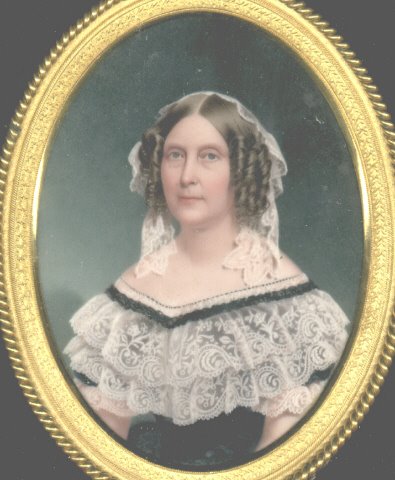
Brown, John Henry - portrait of Mrs Maria Cadwalader


Dating from 1860 is this miniature portrait signed "J. Hy. Brown 1860" for John Henry Brown. The year of 1860 is the same year that Brown painted his famous miniature portrait of Abraham Lincoln, see Abraham Lincoln by John Henry Brown

Brown charged $180 to paint this portrait of Mrs Cadwalader and $175 to paint a miniature portrait of Abraham Lincoln. This collector observes, a little wistfully, that the close parity of value in 1860 does not apply today! For an interesting site that discusses portraits of Lincoln see The Youngest Face of Abraham Lincoln? - Miniature Artists

The sitter in this miniature is identified on a tag as "Maria Charlotte Gouverneur m Thomas Cadwalader". Maria Charlotte Gouverneur (1801-1861) was the daughter of Nicholas Gouverneur and Hester Kortright. She married Major General Thomas Cadwalader (1795-1873) on Dec 27, 1831. Maria's aunt (i.e. her mother's sister) was married to President Monroe, so Maria was well connected. For reference to Maria's burial place see http://www.findagrave.com/cgi-bin/fg.cgi?page=gsr&GSln=Cadwalader& Maria and Thomas had five children, of whom Maria in the adjacent portrait was the youngest.

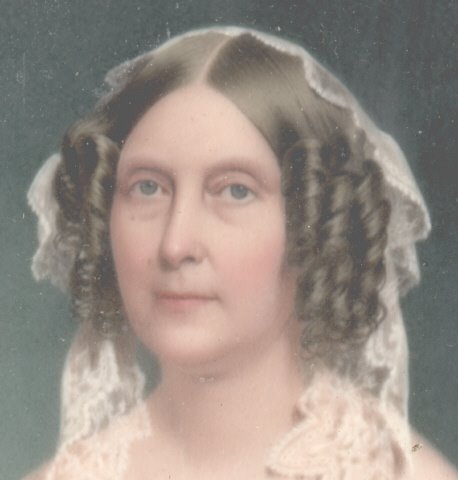
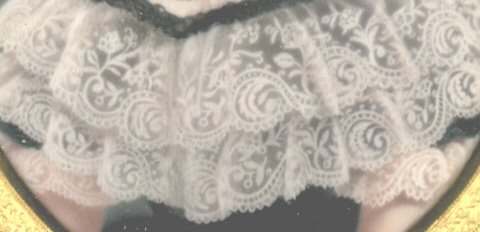
The detail of the lace in the painting of Maria is amazing. (If you click on the photo of the lace you will get a larger version.) The two Cadwalader portraits were acquired for this collection two years apart, and so it was nice to be able to reunite mother and daughter.

Brief details of Maria's husband are as follows; CADWALADER, Thomas, soldier, was born at Greenwood, near Trenton, N. J., Sept. 11, 1795; son of Lambert and Mary (McCall) Cadwalader. He graduated at Princeton in 1815 and studied law, but did not practise. He was appointed, June 2, 1830, deputy adjutant-general in the Hunterdon Brigade of the New Jersey militia, and on April 10, 1833, lieutenant-colonel and aid-de-camp to Governor Seeley. On July 30, 1842, he was commissioned brigadier-general and made Adjutant-General of New Jersey. In 1856 he was sent by the governor to Europe, to report on the firearms in use in the European countries. In March, 1858, he was brevetted major-general by the legislature. He died at Greenwood, N. J., Oct. 22, 1873.

Although it is not of Cadwalader himself, in the American 2 portion of this collection and also shown here, there is a miniature of a brigadier-general in a more recent militia uniform, but one can get some idea of what his uniform would have looked like. 802. 1176