Saturday

Alexander, J B - portrait of two children

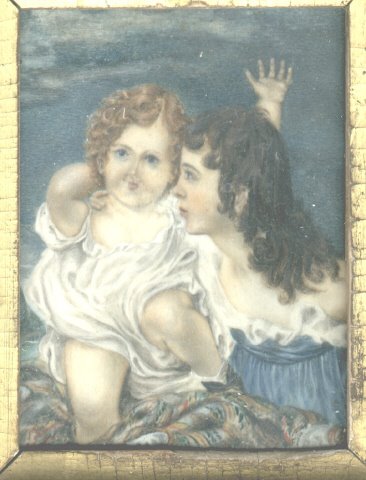
This miniature portrait is signed J B Alexander. Reference books say little about him other than that a J B Alexander was active in Charleston between 1830 and 1840.

However, a J B Alexander (1812->1880) has now been located in the 1850 census for Camden, Kershaw, SC, where he gave his age as 38, his occupation as artist, his assets as $2000, and his place of birth as South Carolina. He was living with his wife E A (E M?) Alexander aged 36 and several children; Ann Alexander 15, Jas (?) Alexander 12, A A Alexander 10, G G Alexander 5, and J H Alexander 2 who were all born in SC. A teacher from Canada called I P Lee also lived with the family.

He was still there for the 1860 census, but now described himself as a silversmith, his assets as $14,600 and they had two more children M M Alexander 10, and W S Alexander 6 mths. There was also a S Norton (Horton?) aged 75 living with them, perhaps his mother-in-law. He presumably changed his occupation due to the lack of painting commissions, after the advent of photgraphy, but must have been successful as a silversmith for his assets to increase so much in ten years.

In the 1880 census he still lived in Camden, although now a widower, and with the occupation of jeweller. His son Geo C Alexander, a newspaper publisher, lived with him. They family has not yet been located in the 1870 census, although it seems likely that George was the George Alexander from SC who was working as a printer in NY in 1870. His age was given as 20, but all ages in that census return are rounded to the nearest ten years.

The sitters in the miniature are unknown, but it is even possible his children modelled for this miniature. 948

Ames, Daniel - portrait of a lady


This miniature portrait is signed "? Ames 1851". Unfortunately, the first initial is hard to read, but presumably it is Daniel F Ames (1815-?) who was active in New York from 1837 to 1858, and the only member of the family whose dates fit.

In the 1850 census, Daniel F Ames aged 35 lived with his wife, Ann aged 34 and five children aged 5 to 17, in the 20th Ward of Brooklyn, New York. He gave his place of birth as New York and occupation as painter. He must have married at age 18 and moved about as two of his children were born in New Jersey

The sitter is unknown. 1054

Barratt, Thomas E - portrait of Joshua Elder


This miniature portrait is unsigned, but has been attributed to Thomas E Barratt (1811-?) who was active in Philadephia (1833-1854). In the 1850 census he was living in Dock Ward, Philadelphia, aged 39, gave his occupation as Miniature Painter, and was living with his wife Elizabeth B Barratt and daughter also named Elizabeth. All three were born in England. Living with them were Edward Williams a Performer, and Manual Eyre an Agent, but it is not known what type of performer Williams was. There was also a servant, so Barratt must have been a successful artist at this stage.

The case is engraved on the reverse "Presented to Mrs E S Elder by Joshua Elder". Joshua Elder married Eleanor Sherer (1802-1837) on Mar 12, 1826. See Joshua Elder & Eleanor W Sherer

Both Eleanor and Joshua are buried in Paxtang and it seems likely Joshua was related to the the Joshua Elder who was Pastor of the Presbyterian Church and a slave owner, see Joshua Elder Slave Advertisement where there is this advertisement;


This miniature is illustrated in Wehle, plate XXXV and is also referred in Schidlof, but in both places the sitter is mistakenly referred to as Josiah Elder. Unfortunately, since the photograph was taken for the plate in Wehle, a vertical crack has appeared. 892

Berger, Charles F - portrait of a man


This miniature is signed on the reverse by C F Berger and dated 1842. Charles F Berger was active in Philadelphia between 1841 and 1880.

It seems likely he is the Charles F Berger listed in the 1860 census for Ward 14 in Philadelphia. Here he stated he was an artist, aged 49 and born in Hamburg. He disclosed real estate assets of $4000 and personal assets of $800 and was living with his wife Mary aged 37 and four children, Anna J 18, Mary E 16, Charles T 14, and Clara A 11. As his wife and children were all born in Pennsylvania, he must have arrived in the United States not later than around 1840.

In the 1850 census, he had stated he was a painter but gave an age of 37, so he must have been born around 1812. There was a servant living with the family in 1850, but not in 1860, which is perhaps a sign that the advent of photography had impacted on his income.

In the 1870 census, the enumerator did not complete the personal particulars for Charles, Mary, and Clara, but they did still seem to be living in their own home. However, by the 1880 census, Charles 69, Mary 60, and Clara 30, were living together as boarders in a boarding house with a number of other families. Charles gave his occupation as portrait artist, but it seems the family was even less well off.

The sitter is unknown. 486

Blood, M I - portrait of a girl


This miniature portrait is signed "M I Blood", but no record of the artist has been found. Judging by the design of the case, it may be South American. The sitter is unknown. 974.

 This is one of over a dozen American portraits in the collection, from around 1830-35, all depicting young ladies wearing a "little black dress", and thus indicating the 19C origin of the proverbial fashion item, of  a "little black dress" usually claimed as being in the 1920's.

Boudon, David - portrait of a man


This miniature portrait in silverpoint is inscribed on the reverse, but it is difficult to read. It looks like "David Boudon Fecit aber 08 86". The two words David Boudon are quite clear and the signature matches figs. 178 and 179 in "100 Ans de Miniatures Suisses". David Boudon (1750-1816?) was born in Switerland, but emigrated to America and worked in Philadelphia.
There are detailed articles about him in "100 Ans De Miniatures Suisses" pp139-146 and "Wintatur Portfolio 9" pp77-101.
The sitter is unknown. 646a

Boudon, David - portrait of a lady

This miniature portrait in silverpoint is signed on the reverse. However, paper has been stuck to it and it is illegible. Nevertheless, it is possible to confirm the word "aber" in the same handwriting as on the reverse of the adjacent miniature by Boudon. The sitter is unknown. 646b

Brown, Abby Mason -portrait of a lady


This miniature portrait is signed "A Brown", possibly for Abby Mason Brown, who was active in New England (1800-1822). The case is not original. The sitter is unknown. 351

Brown, Henry I - portrait of a man


This miniature portrait is signed "H Brown" for Henry I Brown (1822->1880) who is recorded as active in Boston (1844-1851). The sitter is unknown. It is thought that, as Brown tended to use thickly applied paint, that he also painted oil portraits.

His self described occupation of painter in the 1850 census as shown below, supports this view. Although by the 1880 census, he describes himself as house painter. Thus it seems likely that as the daguerreotype tended to displace miniature painting around 1850 and none of his works are known dated after 1851, he turned to house painting to support his family. Nevertheless, as he lived in Salem for over thirty years, it seems likely he painted many large oil portraits over that period.

It seems fairly certain he is the Henry Brown 3rd listed in the 1850 census for Salem Ward 1 in Essex, Ma. There he was living as a lodger with his wife Mary E Brown and gave his occupation as painter, his age as 29 and his place of birth as England.

In the 1860 census he still lived in Salem with Mary and gave his occupation as painter, although now he described himself as Henry Brown Jr and his age as 37. Inthe 1870 census he is again in Salem with Mary and three children, Henrietta, Minnie, and Henry. His occupation is described as "works painting" and his age is 45. In the 1880 census he gives his age as 58 and his occupation as house painter. He must have died before 1900, as his wife Mary E Brown appears to be living in Salem as a widow in the 1900 census. 899

Brown, John Henry - portrait of Mrs Antoinette Wilmer


Painted in 1852 is this miniature portrait signed on the reverse "Copied from a daguerreotype J Henry Brown pinxit Phil 1852". John Henry Brown (1818-1891) was active as miniature painter in Philadelphia for a number of years. He was highly thought of and won a medal at the 1876 exhibition. He was one of very few miniaturists who were able to compete with the new art of photography.


Brown charged $125 to paint this portrait, which was a lot of money at the time and equivalent to around $5000 today. This and the following group of miniatures show a good cross-section of his work.
There is an excellent article about John Henry Brown by Anne Verplanck, in The Magazine Antiques for November 2004 see Magazine Antiques: The art of John Henry Brown
 

The sitter is Antoinette Tessieire Wilmer and was identified from a note on the reverse where she is described as "Mrs Ringold Wilmer - mother's sister - sister of Mrs James C Fisher". Research has identified Antoinette Tessieire (1817-c1852) who married John Ringgold Wilmer (1813-1886) on Nov 9, 1847. In the 1850 census John Ringgold Wilmer was aged 32 and described himself as a merchant. Antoinette is recorded as aged 23 and is seems likely she died in childbirth a year or two later. John Ringgold Wilmer was married for a second time in May 1855 to Marie Jeanne Nathalie de Chazournes (1827-?). 


Given the date of 1852 on the reverse of the miniature, it appears that the miniature was painted from a daguerreotype shortly after Antoinette's death, possibly at the request of her mother, Eliza Tesseire. Verplanck mentions a similar instance regarding a portrait of Mrs Henry Fisher (this Fisher family appears to be unrelated to the Mrs James C Fisher referred to here). 


The wife of James Cowles Fisher was Mary Tessieire (Mary Tesseire) who he married 29 Apr 1847. She was another daughter of the Eliza Tessieire in the adjacent miniature and this explains the reference to "mother's sister". James was the grandson of the James Cowles Fisher who married the Nancy Wharton (aka Ann Wharton) who is the sitter in the miniature by Edward Heaton which appears elsewhere in this section. 


On the rear of the frame, there is a framemaker's label which reads "G Sauter, Manufacturer of Looking Glasses, Picture Frames & Passe-partouts, Also, dealer in Paintings, Engravings, Chromos. and other works of art. 138 South Eighth Street Philadelphia". The identical framemaker's label appears on the reverse of the miniature portrait in this Gallery by George Lethbridge Saunders. In the 1860 census George Sauter (1837-?) was living in Philadelphia with his parents, Charles F Sauter, who seems to have had a furniture store, and Caroline Sauter. George gave his occupation as "manufacturer of P Partouts". A passe-partouts is a mounting for a picture in which strips of gummed paper bind together the glass, the picture, and the backing, for insertion in the frame. The business must have been quite profitable in 1860 as George disclosed assets of $4000. By 1870 he was married to Christina Sauter and they had a daughter Mary Sauter, aged 2, but by 1880 he was living only with his mother, and even later in 1900 he was living as a lodger and his occupation was art dealer. 1100

Later, a kind visitor advises;
1- The portrait miniature of 'Mrs Geo W Morgan - Grandmother
Tessiere's mother' is of Hester Leib, wife of George Washington
Morgan. George Washington Morgan was born in 1776; he was the son of
Gen Jacob Morgan of the American Revolution. The Morgans were
merchants and heavily involved in shipping and the West Indies (sugar)
trade. George Washington Morgan and Hester Leib had 4 surviving
children: Eliza Caroline (m.Anthony Teisseire), Mary (m.Saturnius
Destouet), Harriet Adelaide (m.Thomas Ashton Morgan), and George Leib
Morgan (m.Lucretia Elizabeth Hamersley).

2- The Destouet family ('portrait of Mary Morgan Destouet').
Saturnius Destouet and his two brothers, Bartholomew & John E, were
merchants in Philadelphia under the name 'Destouet Brothers'. Bartholomew may have
died or returned to France by the late 1820s; only Saturnius and John
E show up in the later records. Their father's name was John; there
were also two sisters, Adele and Zelie, born about 1802 and 1807
respectively.
The father, John, along with Adele and Zelie, left the United States
in 1831 to travel in Europe; I haven't found any record of their
return to the US. Eliza Caroline Destouet, daughter of Saturnius & Mary
(Morgan) Destouet, married her 1st cousin, Thomas Hamersley Morgan,
son of George Leib & Lucretia Elizabeth (Hamersley) Morgan. The Rev Brockholst
Morgan who married them was Thomas' brother.

3- The wives of John Ringgold Wilmer ('portrait of Antoinette
Teisseire') were cousins. JRW's first wife was the daughter of
Anthony and Eliza Caroline (Morgan) Teisseire. JRW's second wife, Marie Jeanne Nathalie
de Chazournes, was the daughter of Felix and Marie Louise (Brugiere)
Chazournes. Marie Louise (Brugiere) Chazournes was the daughter of Charles and
Marie Antoinette (Teisseire) Brugiere. Marie Antoinette (Teisseire)
Brugiere was the sister of Anthony Teisseire.

Charles Brugiere originally worked for the firm 'Tarascon Brothers,
James Berthoud & Co'. They were Philadelphia merchants who later
established the town of Shippingport, Kentucky. After the Teisseire family's
arrival in Philadelphia in about 1800, Charles Brugiere and Anthony
Teisseire established the firm of Brugiere and Teisseire.

In about 1843, Charles and Marie Antoinette (Teisseire) Brugiere's
son, William, married Mary Morgan, daughter of Thomas Ashton and
Harriet Adelaide (Morgan) Morgan, thus completing the circle of Morgan,
Teisseire, and Brugiere.

One additional note - Thomas Ashton Morgan and his wife, Harriet
Adelaide Morgan were also cousins. Thomas' father, Benjamin, was a
brother of Gen Jacob Morgan. Gen Jacob Morgan was Harriet Adelaide's grandfather.

Brown, John Henry - portrait of Mrs Eliza Tessieire


Painted in 1858 is this miniature portrait, signed "J Hy Brown 1858" for John Henry Brown.  

The sitter has been identified, with kind assistance from the Rosenbach Museum and Library, as Mrs Eliza Tessieire. John Henry Brown charged $180 to paint this portrait. Eliza Caroline Morgan married Anthony Tessieire on March 19, 1813 in Philadelphia. 

See also; 

John Henry Brown | Smithsonian American Art Museum

Eliza's mother, Mrs Geo. W Morgan is the sitter in a miniature by George Lethbridge Saunders elsewhere in this American 1 gallery. Based upon the census information in the attached comments, Eliza was born in 1798 and thus only 15 when she married, and 60 when this miniature was painted. She was widowed before 1850, but by 1870 she had a personal fortune of $200,000, equivalent to around $10,000,000 today! 

Little is known about the Tessieire family, although on page 159 of "Salons Colonial and Republican", Anne Hollingsworth Wharton observes that a large number of the leading citizens of Saint Domingo immigrated to America when they were driven hither by the uprising in the island. These immigrants included the Tessieire (Tesseire) family and presumably Anthony was one of these. Although no relevant reference has yet been found, the Tessieire family presumably had also been slave owners in St. Domingo, and emigrated (or fled?) to the United States around 1804, i.e. after the Haiti Massacre. 

The most significant slave uprising in Saint-Domingue (now Haiti) was the Haitian Revolution (1791-1804), a successful revolt against French rule that created the first free black republic. The 1791 rebellion, sparked by the French Revolution's ideals and led by figures like Toussaint Louverture, grew from localized unrest into a full-scale war for independence, ultimately succeeding where others failed.

Saint Domingo Massacre of 1804

The 1804 Haiti massacre was carried out by Haitian rebel soldiers, mostly former slaves, under orders from Jean-Jacques Dessalines against much of the remaining European population in Haiti, which mainly included French Colonists. The Haitian Revolution defeated the French army in November 1803 and the Haitian Declaration of Independence happened on 1 January 1804.

The name Teisseire is still a well-known French manufacturer of non-alcoholic flavored syrups, established in 1720. They produce a wide range of fruit and plant-based syrups (e.g., passion fruit, mango, mint, etc.), including a non-alcoholic rum flavor syrup, but none of the current product lines or historical products are named "Saint Domingo". However, given the similarity of name and the sugar based product. it seems likely that an earlier generation of the Teisserie family was sent to Saint Domingo to manage a sugar plantation or to purchase sugar syrup, for shipment back to France. 

The Saint Domingo export business likely continued after the family left Haiti, and some profits from that and related activities, presumably still flowed to Eliza Tessierie in America, and explain why in 1870 she had assets of $200,000. The company was founded in Grenoble by Mathieu Teisseire in 1720. The Teisseire district in the city is named after the family. A distiller by trade, Teisseire originally manufactured vinegars and Ratafia de Teisseire, a type of cherry liqueur which he had invented and which made his family's fortune. The 18th-century Venetian adventurer Giacomo Casanova was particularly fond of Teisseire's ratafia and described it in his memoirs, Histoire de ma vie, as "the divine liqueur of Grenoble".He went on to write: "This excellent liqueur is composed of cherry juice, eau de vie, sugar, and cinnamon, and it would be impossible for the nectar of the gods on Olympus to surpass it in delicacy." The Teisseire business, which was located at Place Grenette in Grenoble, then passed to Mathieu's son, Mathieu II. With the death of Mathieu II in 1781, it was run by his widow and younger son Camille Teisseire whom he had named as his principal heir. For some time after Mathieu II's death, the company was known as Veuve Teisseire & Fils (The Widow Teisseire and Son) For more of the history of the company, see 

Teisseire (company)

Mrs Eliza Tessierie is believed to be the mother of Antoinette Tessieire (Mrs John Ringgold Wilmer) who is the sitter in the adjacent portrait and of Mary Tessieire who married James Cowles Fisher. As can be seen from the census detail, there were various and continual misspellings of her surname.
This means there are three generations of sitters in the collection; Mrs Geo W Morgan as mother; Mrs Eliza Tessieire as daughter; and Antoinette Wilmer as granddaughter. It seems most likely that these three portraits, together with the one of Mrs James C Fisher had belonged to one of the children of James Cowles Fisher and Mary Tesseire Fisher, and were passed down until sold by auction in 2005. 1101

Later, a kind visitor advises;
1- The portrait miniature of 'Mrs Geo W Morgan - Grandmother Tessiere's mother' is of Hester Leib, wife of George Washington Morgan. George Washington Morgan was born in 1776; he was the son of
Gen Jacob Morgan of the American Revolution. The Morgans were merchants and heavily involved in shipping and the West Indies (sugar) trade. George Washington Morgan and Hester Leib had 4 surviving children: Eliza Caroline (m.Anthony Teisseire), Mary (m.Saturnius Destouet), Harriet Adelaide (m.Thomas Ashton Morgan), and George Leib Morgan (m.Lucretia Elizabeth Hamersley).

2- The Destouet family ('portrait of Mary Morgan Destouet'). Saturnius Destouet and his two brothers, Bartholomew & John E, were merchants in Philadelphia under the name 'Destouet Brothers'. Bartholomew may have died or returned to France by the late 1820s; only Saturnius and John E show up in the later records. Their father's name was John; there were also two sisters, Adele and Zelie, born about 1802 and 1807 respectively. The father, John, along with Adele and Zelie, left the United States in 1831 to travel in Europe; I haven't found any record of their return to the US. Eliza Caroline Destouet, daughter of Saturnius & Mary (Morgan) Destouet, married her 1st cousin, Thomas Hamersley Morgan, son of George Leib & Lucretia Elizabeth (Hamersley) Morgan. The Rev Brockholst Morgan who married them was Thomas' brother.

3- The wives of John Ringgold Wilmer ('portrait of Antoinette Teisseire') were cousins. JRW's first wife was the daughter of Anthony and Eliza Caroline (Morgan) Teisseire. JRW's second wife, Marie Jeanne Nathalie de Chazournes, was the daughter of Felix and Marie Louise (Brugiere) Chazournes. Marie Louise (Brugiere) Chazournes was the daughter of Charles and Marie Antoinette (Teisseire) Brugiere. Marie Antoinette (Teisseire) Brugiere was the sister of Anthony Teisseire.

Charles Brugiere originally worked for the firm 'Tarascon Brothers, James Berthoud & Co'. They were Philadelphia merchants who later established the town of Shippingport, Kentucky. After the Teisseire family's arrival in Philadelphia in about 1800, Charles Brugiere and Anthony Teisseire established the firm of Brugiere and Teisseire.

In about 1843, Charles and Marie Antoinette (Teisseire) Brugiere's son, William, married Mary Morgan, daughter of Thomas Ashton and Harriet Adelaide (Morgan) Morgan, thus completing the circle of Morgan, Teisseire, and Brugiere.

One additional note - Thomas Ashton Morgan and his wife, Harriet Adelaide Morgan were also cousins. Thomas' father, Benjamin, was a brother of Gen Jacob Morgan. Gen Jacob Morgan was Harriet Adelaide's grandfather.

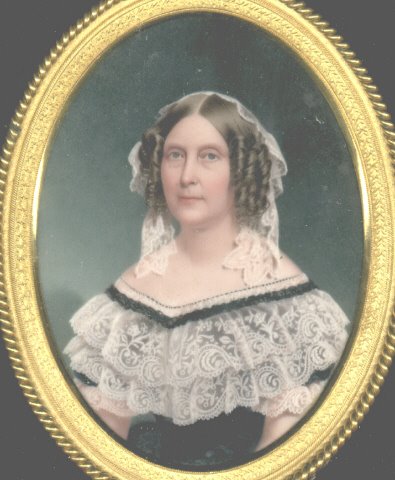
Brown, John Henry - portrait of Mrs Maria Cadwalader


Dating from 1860 is this miniature portrait signed "J. Hy. Brown 1860" for John Henry Brown. The year of 1860 is the same year that Brown painted his famous miniature portrait of Abraham Lincoln, see Abraham Lincoln by John Henry Brown

Brown charged $180 to paint this portrait of Mrs Cadwalader and $175 to paint a miniature portrait of Abraham Lincoln. This collector observes, a little wistfully, that the close parity of value in 1860 does not apply today! For an interesting site that discusses portraits of Lincoln see The Youngest Face of Abraham Lincoln? - Miniature Artists

The sitter in this miniature is identified on a tag as "Maria Charlotte Gouverneur m Thomas Cadwalader". Maria Charlotte Gouverneur (1801-1861) was the daughter of Nicholas Gouverneur and Hester Kortright. She married Major General Thomas Cadwalader (1795-1873) on Dec 27, 1831. Maria's aunt (i.e. her mother's sister) was married to President Monroe, so Maria was well connected. For reference to Maria's burial place see http://www.findagrave.com/cgi-bin/fg.cgi?page=gsr&GSln=Cadwalader& Maria and Thomas had five children, of whom Maria in the adjacent portrait was the youngest.

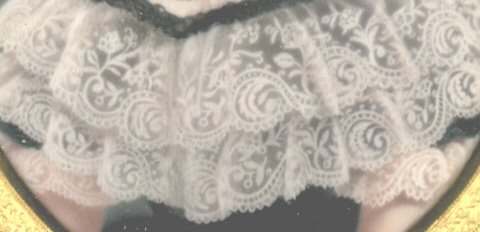
The detail of the lace in the painting of Maria is amazing. (If you click on the photo of the lace you will get a larger version.) The two Cadwalader portraits were acquired for this collection two years apart, and so it was nice to be able to reunite mother and daughter.

Brief details of Maria's husband are as follows; CADWALADER, Thomas, soldier, was born at Greenwood, near Trenton, N. J., Sept. 11, 1795; son of Lambert and Mary (McCall) Cadwalader. He graduated at Princeton in 1815 and studied law, but did not practise. He was appointed, June 2, 1830, deputy adjutant-general in the Hunterdon Brigade of the New Jersey militia, and on April 10, 1833, lieutenant-colonel and aid-de-camp to Governor Seeley. On July 30, 1842, he was commissioned brigadier-general and made Adjutant-General of New Jersey. In 1856 he was sent by the governor to Europe, to report on the firearms in use in the European countries. In March, 1858, he was brevetted major-general by the legislature. He died at Greenwood, N. J., Oct. 22, 1873.

Although it is not of Cadwalader himself, in the American 2 portion of this collection and also shown here, there is a miniature of a brigadier-general in a more recent militia uniform, but one can get some idea of what his uniform would have looked like. 802. 1176

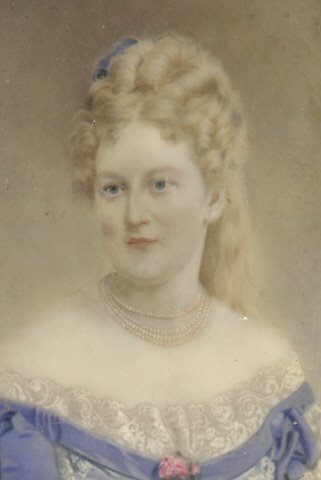
Brown, John Henry - portrait of Mrs Maria Cadwalader Hone

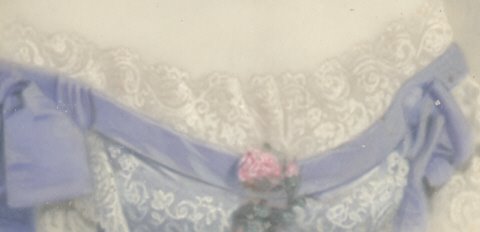
Unusually painted on milk glass, is this miniature portrait believed to be by John Henry Brown. As it is painted on milk glass, it may be somewhat of an experiment. It is signed in very tiny letters and faintly "JHB" above the left shoulder, just level with her necklace.

He generally signed his miniature portraits on ivory, but not his opalotypes which were hand coloured photographs by him on a milk glass ground. This miniature seems to fall somewhere between the two types.

The miniature is identified by an attached tag as "Maria Cadwalader - Mrs John Hone - (H G Bartol's) - Mrs G M Phelps grandmother". Maria Cadwalader (1843-1921) married John Hone (1844-1915) on April 29, 1880. By the apparent age of the sitter, the miniature must have been painted in the 1860's.

The miniature was exhibited as item 31 at the Tenth Annual Exhibition of Miniatures at the Philadelphia Academy of Fine Arts (PAFA) in 1911, where it was described as "Mrs John Hone (nee Cadwalader) painted in Philadelphia by J Henry Brown lent by Mrs S Weir Mitchell".

Maria Cadwalader Hone was the daughter of Maria Gouverneur Cadwalader in the adjacent portrait. A kind visitor to the website who is a descendent of Maria Cadwalader Hone, has advised that her husband, John Hone, is the grandson of Commodore Matthew Perry whose miniature portrait appears elsewhere in this American 1 Gallery, see Gelee, Isabelle - portrait of Commodore Perry

The PAFA catalogue of 1911 is a rare document and very few items are illustrated. However, to assist any Cadwalader researchers, two images from the catalogue do seem to relate to the broader family and are reproduced here.

They are of Wilhelmina, wife of General John Cadwalader and Mrs John K Mitchell, said to be by Saunders, which will be George Lethbridge Saunders. Mrs Mitchell seems to have been either the mother or, perhaps more likely, the grandmother of the Dr Silas Weir Mitchell mentioned in this description.


Research is made easier by the Internet, as people all over the world can research and readily share information.

Another interesting contact with information about Maria Cadwalader Hone has been from a kind visitor who has a photo album which once belonged to the Cadwalader family. A small, but interesting selection from the photo album is shown here. Apparently, pencil notations in the album suggest it was kept by Maria Cadwalader (from before she became Mrs John Hone), daughter of Thomas McCall Cadwalader and Maria Gouverneur, and then passed through to her grandchildren, before leaving the family.

The portraits include one of Maria Cadwalader, the subject of this miniature, with one of her sisters, Mary Cadwalader, who married Dr Silas Weir Mitchell in 1875. He was well known in medical circles, see Silas Weir Mitchell (www.whonamedit.com) Also a family group with croquet mallets in front of them and with Maria Cadwalader Hone standing in the rear row.

The other images are photographs of painted portraits, probably all being miniatures of family members, but the whereabouts of the original portraits are currently unknown. One is described in the album as of Mary McCall and the artist appears to be John Ramage.

Another of a young lady at the bottom right below, appears to be by John Henry Brown. The third of a lady with a bonnet on the bottom left, looks to be a miniature by George Lethbridge Saunders, but appears not to be mentioned in the PAFA catalogue, unless it is the one of Miss Maria Sergeant (Mrs Harrison Smith) which was loaned by Miss M H Smith.

The sitter in the photograph of the miniature at the bottom right by John Henry Brown is also hard to identify. The wider Cadwalader family seems to have only loaned one miniature of a female by John Henry Brown to the 1911 exhibition, and that is believed to be the one in the colour image of Maria Cadwalader Hone in this posting, although several of females were loaned by other owners. Thus further information about any of these portraits would be welcome.

For the benefit of anyone researching the Cadwalader family, or their related families i.e. Biddle, McCall, Gouverneur, Weir Mitchell etc. three sources that have been discovered are firstly, a series of books by Anne Hollingsworth Wharton written around 1900.

Secondly, the catalogue for a PAFA exhibition of miniatures held in 1911. The Mrs Weir Mitchell (Mary Cadwalader) mentioned above and her husband, loaned a large number (24) of miniature portraits of family members to the exhibition, possibly including the one of Mary McCall by John Ramage shown here, as the 1911 exhibition included a portrait by a then unknown artist of Mrs Lambert Cadwalader (nee Mary McCall).

Thirdly, an extensive family tree can be seen at RootsWeb's WorldConnect Project: "The Large Version of the Chew ... There is also a miniature in this collection which may possibly represent Nicholas Biddle at Gillespie, J H - portraits of Alexander H Niven an...


Unfortunately, the whereabouts of all these miniatures is unknown, but they may still be with a family member somewhere.

In late 2007, I have found a 1999 auction reference to the sale of one of the miniatures by Skinners of Boston. (Unfortunately, the image is very poor.) The description reads; "Miniature Portrait of Mary McCall Cadwalader Unsigned, attributed to John Ramage, line of descent inscribed on the reverse Watercolor on ivory, 1 1/2 x 1 1/4 in, in a pendant frame Condition: Good Provenance: From the script on the reverse of the gold locket: "nee McCall left her miniature to her niece, namesake and Godchild, Mary Read who left it to her daughter Mary Read Fisker who give it to Hester Gouveneur Hone great grand-daughter of Mary McCall Cadwalader 4th December 1907" Note: "The Cadwalader family had a distinguished history of leadership and public service in Philadelphia from its carliest years and they continued to play a pivotal role in the city's political, intellectual, and cultural circles during the Revolution and in later Federal periods " according to "The Cadwalader Family Art and Style in Early Philadelphia," by Jack Lindsey and Darrel Sewell, Philadelphia Museum of Art Bulletin Fall, 1996."

Dr and Mrs Weir Mitchell had a daughter Maria Gouverneur Mitchell who unfortunately died of diphtheria in 1898 at the age of 22. In memory of her, they commissioned a memorial sculpture from Augustus Saint-Gaudens which is inscribed, "Blessed are the pure in heart for they shall see God."

It was the Angel of Purity (Maria Mitchell Memorial), is 96 inches tall and adorned the wall facing the Cadwalader family pew in Saint Stephen's Episcopal Church in Philadelphia for over 100 years until it was acquired by the Philadelphia Museum of Art in 2005.

It is shown here for convenience, but much more about the sculpture can be found at Philadelphia Museum of Art - Collections : New Acquisitions 184

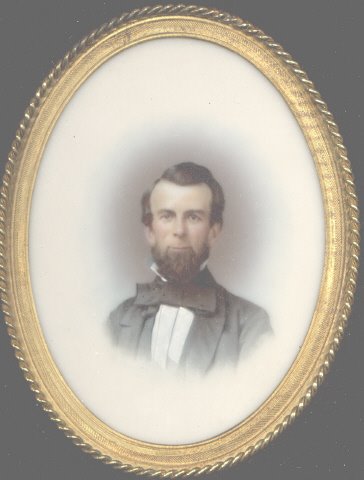
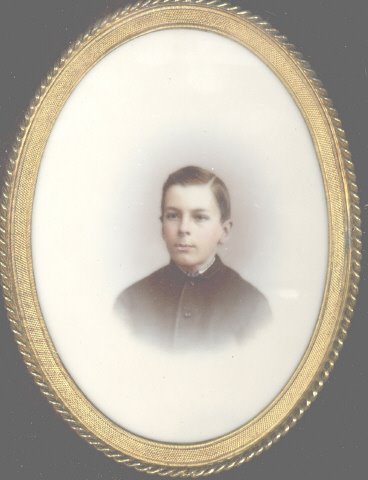
Brown, John Henry - portraits of a father and son


This pair of miniature portraits are opalotypes by John Henry Brown (compare plates V and XI in Verplanck).

Opalotypes were based on a photographic image on milk glass, but then hand painted over the image so that they looked like miniatures on ivory. Thus they were a cheaper form of portrait than those on ivory, but were in colour and had lasting qualities that were then absent from other types of photographs.

John Henry Brown was the prime exponent of the technique. He did not sign his opalotypes, but he used the same frames as for his miniatures on ivory and so it is fairly certain that opalotypes in these frames are by him. Generally also his opalotypes were bust portraits only without any background.

Thus these portraits are framed in the typical style of frame that Brown used and are contained in the same outer case. The sitters appear to be father and son, but are unknown. 979a, 979b

Brown, John Henry - portrait of a lady


This miniature portrait is painted by John Henry Brown, but it is impossible to tell whether it is painted over an opalotype base, or is a straight bust portrait painted on milk glass. It is framed in the same way as most of his other miniatures and opalotypes.

As John Henry Brown was noted for his ability to make his painted miniatures look like photographs, the difference in quality between the miniatures and some of the opalotypes is so minimal it is really difficult to differentiate between miniatures on ivory and some of the opalotypes.

The adjacent portraits of a man and a boy seem to be definitely opalotypes, but this one may be a painted portrait based on a CDV photographic portrait. A point in favour of this is that there is some paint loss on her hair and there is no sign of a photographic base in the area thus uncovered. Brown did paint copies of photographs and this collection includes a miniature on ivory of Antoinette Tesseire which was a post mortem portrait copied from a daguerreotype.

This sitter is unknown. 1218

Brown, John Henry - portrait of a girl


This miniature portrait is unsigned. It is in the style of John Henry Brown (compare item 23 in the Manney Collection) and in an American frame, but may not be by him. The sitter is unknown. 500

Cummings, Thomas Seir - portrait of a man

This miniature portrait has been attributed to Thomas Seir Cummings (26 Aug 1804-25 Sep 1894) who worked in New York and whose works have been described as "technically flawless". He taught miniature painting and drawing for over thirty years. He exhibited annually at the National Academy of Design from 1826-1852

Cummings had been born in Bath England, but was brought to New York by his parents. He married Jane Cooke (9 Dec 1806-20 Nov 1889) in New York on 27 May 1822, thus Thomas was less than 18 years old when he married and Jane only 15. As Jane died first in 1889, they were married for 67 years, unusual today and almost unheard of in the 19C.

It is difficult to trace the family through the census returns, but in 1850 Thomas described himself as an artist, with assets of $8000. At that time he and Anne had ten children, aged from 3 to 25, and one servant.

The attribution is based upon a comparison with fig 42 in the Manney Collection, which has a similar pose and background treatment with a vertical colour change, as well as similar sight size dimensions.

Johnson describes Cummunings' work as "techinically flawless and pyschologically perceptive. Although Cummings a precise painter, lacked the painterly freedom of Inman, he achieved lively, charming effects by his use of striking contrast and brilliant color."

Additionally, a pair of portraits by Cummings with the similar pose and background treatment of a vertical division were sold as lot 815 in the Skinner sale of 5 November 2006.

Unfortunately the sitter in this portrait is unknown. 1194b

Friday

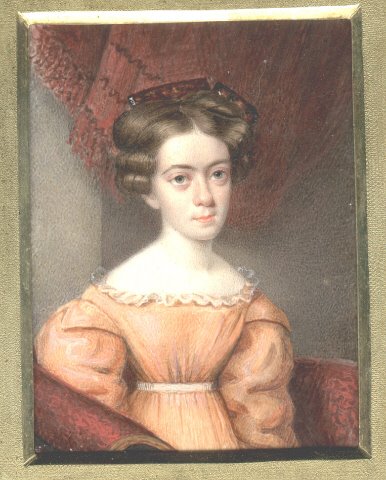
Doyle, William - portrait of Anne Tuttle Jones Bullard


Although this miniature portrait has not yet been firmly attributed to an artist, stylistically, the most likely artist seems to be William Doyle (1787-1828) who worked in Boston.


Initially, it was thought there are some similarities with the work of Nathaniel Rogers, as Rogers tended to make the heads of ladies disproportionately large and the bodies small, but Rogers worked in New York and this sitter came from closer to Boston.


The portrait is inscribed on the reverse "Ann Tuttle Jones 1808-1896 - 1826 date of picture". On the Internet she is referred to as Anne Tuttle Jones Bullard, that is Ann spelled with an "e".

Effectively forgotten for 150 years, Anne deserves belated recognition. In brief, Anne was a published author by the age of 22, writing several fiction books and one non-fiction book, she married and moved westward with her husband Rev Artemas Bullard and so enabling early settlers to take their faith with them. Six of her seven children died in infancy. She was involved with assisting slaves to escape to Canada. 


In 1850 Anne wrote a series of travel letters from Europe, which were initially published in the "Missouri Republican" newspaper and subsequently republished as a book in 1852.
Anne was the grand-daughter of the widow of Captain Isaac Davis, the first officer to be killed in the Revolutionary War, see Minuteman Isaac Davis His widow, Hannah Brown Davis then married Samuel Jones. For an excellent website with comprehensive information about Hannah Brown Davis Jones, (who later remarried again and became Hannah Brown Davis Jones Leighton) see Hannah Brown Davis Jones Leighton

Hannah and Samuel had a son called Samuel Jones who married Anna Tuttle on 21 October 1806, and Anne Tuttle Jones was a daughter of that marriage, born on 31 January 1808 in Acton, Middlesex, MA.

On 2 June 1829 at Acton, Anne married Rev Artemas Bullard (sometimes Artemus Bullard) the son of Dr Artemas Bullard who purchased this house in 1805 from Mr Hunt, who had purchased it from the first owner Ebenezer Waters who built it in 1767. The elder Artemas Bullard was a successful medical practitioner was appointed by Governor Strong as surgeon of the local infantry regiment and in 1814 was elected as a fellow of the council of the Massachusetts Medical Society.

Thus Anne would have been a frequent visitor to this house. Anne and Artemas soon moved to St Louis, where Artemas trained men for the clergy. Artemas was related by marriage to the Beecher family, as his younger sister, the author Eunice White Beecher (nee Bullard), later married the Rev Henry Ward Beecher, a well known 19C preacher who attracted large crowds to his sermons, see Henry Ward Beecher . In turn Henry was the brother of the famous author Harriet Beecher Stowe. A younger brother of Artemas was Rev Asa Bullard. He was also an author and wrote particularly for Sunday schools, see Asa Bullard . Writing was therefore common in the Bullard family.

Anne seems to have been the first in the family to be published and had five fiction books printed between 1830 and 1835, which makes her one of the earliest American female authors and she was only 22 years old when the first book was published. For details of her early fiction see Chronological bibliography Then, after a long gap, in 1852 she wrote another fiction book titled; "Matrimony; or Love Affairs in our Village Twenty Years Ago". Interestingly, she was still reluctant to disclose her own name as author, instead calling herself "Mrs Caustic". However, the Preface does refer to her earlier books.
Additionally in 1852 Anne published her travel book as noted below. Although there is as yet no firm evidence, it seems very likely that in the 1840's Anne also wrote anonymously for the Sunday School publications edited by her brother-in-law Asa Bullard, such as "Wellspring", which was first published in 1845. It is understood there are a number of articles in "Wellspring" signed "A B". At first glance this could seem to be Asa Bullard, but they may perhaps be more likely to be Anne Bullard.

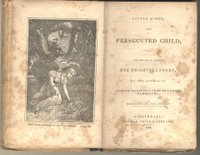
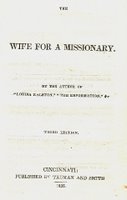
This collection now contains four rare copies of Anne's books, three fiction and one non-fiction. The frontispieces of her books which in this collection are reproduced here, the fiction ones being; "Lousia Ralston" first published in 1831, "The Persecuted Child", with numerous woodcut illustrations, published in 1833, and "The Wife for a Missionary", published in 1835. From reading it, it seems the latter book may well have an element of an auto-biography in it. It is interesting to note that her fiction books were published at a time when women were not supposed to write books. Thus instead of her name on the frontispiece, in the latter book the author is only referred to as "By the author of "Louisa Ralston", "The Reformation" & etc."

In St Louis Artemas Bullard operated a seminary to train young men for the ministry and in 1850 he built the Rock House, which still exists, see Ghosts of Greater St Louis, Missouri

Some St Louis historians also believe that Anne and Artemas assisted with the Underground Railroad aiding escaped slaves. Anne was published as an author, even before her sister-in-law, Harriet Beecher Stowe. Thus it seems entirely possible that Anne's success as an author, and her involvement in the Underground Railroad, was inspiration for Harriet to become an author and to later write "Uncle Tom's Cabin".

However, the involvement in the Underground Railroad around 1850, does seem to be in conflict with the attitude of Artemas Bullard twenty years earlier. In the book "Biography of an American Bondsman" published in 1856, there is an account relating to an incident, which probably took place in 1828, where Artemas Bullard was severely criticised for his attitude towards slaves. See Josephine Brown. Biography of an American Bondman, by His Daughter. The relevant passage is on page 22 and reads;

"It was while acting in this capacity, that a deed of cruelty was committed, which is graphically described by Mr Brown in his published narrative. While driving his master’s carriage to church one Sabbath morning, he saw Mr D D Page, with whom he was well acquainted, chasing one of his slaves around the yard, cutting at him at every jump with a long negro-whip. Mr Page, seeing the truthful charges of Mr Brown published, employed the Rev Dr A Bullard, a pro-slavery, Negro-hating clergyman, formerly of the North, but now of St Louis, to refute the charge; which the Doctor attempted to do so, in a series of articles published in the columns of Northern pro-slavery papers of his own denomination. But the Presbyterian D.D., instead of mending the matter for his patron, made it worse, and caused the public to regards himself as a miserable tool. Mr Page has since failed in his banking business, and swindled his creditors out of large sums; and no doubt lost the misplaced confidence of his renegade theological friend.”

The "published narrative" referred to is the 1847 publication "The Narrative of William W. Brown, a Fugitive Slave", by William Wells Brown, see The Narrative of William W. Brown, a Fugitive Slave by William ...

The incident is described there in similar terms, although there appears to be no direct or indirect reference to Bullard in the Brown narrative. In the absence of a good reason not to, the reference to Bullard must be accepted, even though it seems his involvement was not recorded until the 1856 publication by Josephine Brown, some 28 years after the actual event and one year after Artemas Bullard's death in 1855. As a result, Bullard did not have the opportunity to refute the account. Nevertheless, it would be interesting to research Bullard's writings from around 1828 to try and add to the history of the incident.

The reasons for Artemas Bullard to apparently change his stance towards slavery so dramatically between 1828 and 1850 are unknown, although it may well have been the influence of his wife. He was married to Anne shortly afterwards on 2 June 1829 and from 1830 onwards she was writing books with a strong Christian message. Alternatively it may have been the influence of his brother-in-law, Rev Henry Ward Beecher.

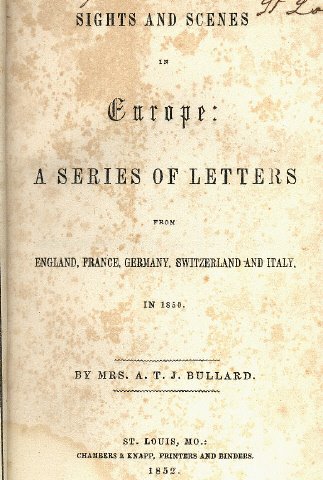
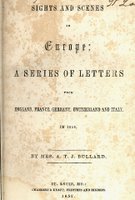
In 1850 Artemas was selected to travel to Europe to attend the 3rd World Peace Congress at Frankfurt on Main and Anne traveled with him. Anne wrote letters back to a St Louis newspaper while she was away and these were later published as a non-fiction book in 1852, "Sights and Scenes in Europe". The frontispiece of this book is also shown here, but by now Anne could be revealed as the author and the book is described as "By Mrs A T J Bullard". However, the frontispiece does not refer to her earlier books. The book is also available online at http://www.hti.umich.edu/cgi/t/text/text-idx?c=moa;idno=ADL7867
The 1850 census must have taken place just before Artemas and Anne left for Europe. On 3 August 1850 they are recorded as A Bullard D.D. (Doctor of Divinity) 49, Anne T Bullard 41, and Henry Bullard 14, all living in St Louis, Missouri.

Less than two weeks later, a highlight of Anne's life must have been on the trip to Europe when she was one of very few invited guests present when Queen Victoria gave a speech to the House of Lords on 15 August 1850. Anne went by herself in a carriage and there were only 30 ladies seated in front of her. She saw and heard the Duke of Wellington, and while waiting for Queen Victoria to arrive, Anne spoke to the lady seated next to her; "In answer to one of my questions, whether such a lady was a Peeress, my companion replied "Oh, yes, we are all Peeresses, you know." I smiled, but did not undeceive her, thinking, as it was the first and last time I should ever pass for a Peeress, I would enjoy my rank."

The book covers her travels in detail and is very interesting. The style, being based upon letters written back to a newspaper, and structure are similar to the famous book written by Mark Twain called "Innocents Abroad", which was written nearly 20 years later. In fact as mentioned below, Anne's son accompanied Mark Twain on that voyage and it seems almost certain they would have taken a copy of Anne's book with them, and it may even have provided some inspiration to Mark Twain. Immigration records show they returned from Liverpool on the SS Europa arriving in Boston on 29 Nov 1850.

In her book, on pages 26 and 27 Anne records seeing "the following curious printed notice". It advertises "Insurance against Steamboat and Railroad Accidents" including cover against death in a railroad accident. Anne describes it in a full page, ending with the comment "What will not be insured next?"

The comment turns out to be very poignant, as only five years later on Nov 1, 1855 Anne's husband was killed in a train crash at Gasconade River, where. Rev Artemas Bullard and over 30 other people were killed, and hundreds were injured when a bridge collapsed. For more on this see Remembering the Gasconade Missouri 1855 Railroad Bridge Disaster An elaborate memorial to Artemas was erected, see Bullard, Artemas . A very kind researcher has found that Anne is buried with Artemas, together with their children who died in infancy, see Bullard, Anne Tuttle Jones . Although I have not seen them, interested researchers can find many of Artemas's papers at %eadnotat; ]> Artemas Bullard (1802-1855) Papers, 1800-1888 (bulk ...

There is a detailed account of Artemas Bullard's career at Annals of the American Pulpit: Or, Commemorative Notices of ... - Google Books Result

Anne and Artemas had seven children, but six of them died in infancy with three of them dying of scarlet fever in one week in January 1848. (some references suggest that the youngest son Edward Payson Bullard survived, however this is due to a mix-up with another Edward Payson Bullard also born in the same area. While this will seem a strange coincidence, there was around this time a book published called "Memoir, Select Thoughts and Sermons of the late Rev Edward Payson'" and it thus seems religious families thought they would be good names to choose, cf. football stars today!). Incidentally, Rev Edward Payson is the author of a quote still relevant today; "Luxury is the first, second and third cause of the ruin of republics. It is the vampire which soothes us into a fatal slumber while it sucks the lifeblood of our veins. "

The single surviving child of Anne and Artemas was Rev Henry Bullard who married Helen Maria Nelson on 30 August 1871 and they had three children.

Another literary link appears here, as Rev Henry Bullard was a passenger along with Mark Twain on the famous Quaker City Pleasure Excursion to Europe in 1867, being right next to Clements on the passenger list; see http://groups.msn.com/RivermenRiverboats/juliusmoulton2.msnw and http://www.twainquotes.com/18670609.html Although there is a reference to Eunice Bullard Beecher being the sister of Rev Henry Bullard, it must be intended as the aunt of Rev Henry Bullard (perhaps to make her seem younger!), as there is no record of Artemas having a brother called Henry. The reference http://72.14.235.104/search?q=cache:j34Qe4k-tTkJ:www.twainweb.net/filelist/skeptic.doc+%22quaker+city%22+bullard+reverend&hl=en&gl=nz&ct=clnk&cd=3 suggests that Rev Henry Bullard temporarily converted Mark Twain to believing in Christianity!!

The miniature portrait of Mark Twain shown here is part of this collection, for more about it and comparisons with other images of Mark Twain, see View

Thus from a high point in 1852; when she had recovered from the death of six children in infancy, met many titled people in Europe, published a new book, and was a prominent local person, Anne's life deteriorated as her income must have ceased after Artemas's death. In the 1860 census she is recorded as Abbie (instead of Annie) T J Bullard, living with her remaining son, Henry and running a boarding house back in Massachusetts. She is next found in the 1880 census apparently as a 74 year old cook/housekeeper to a young widower named Mullin and his young family in St Joseph, Missouri where her son Rev Henry Bullard was now a minister.

Sadly, she died of a broken leg Jan 19 1896 at the age of 88, after 40 years as a widow. 689
Thursday

Unknown - portrait of Aaron Burr


This miniature portrait is unsigned and lacks the artistic skill of an expert artist, being painted in something of a primitive style, but it has been found to be an important item.

The miniature was purchased as an unidentified sitter, but from the research outlined here, it is now believed to be an early portrait of Aaron Burr (1756-1836).

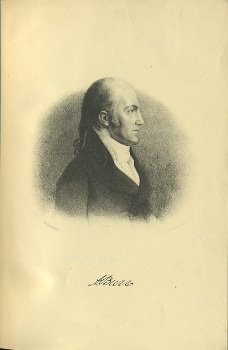
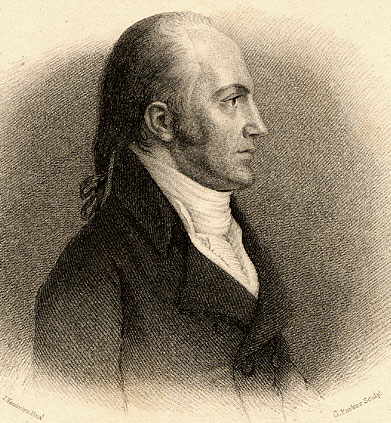
Although based on the original Vanderlyn painting of Burr, it is possibly copied from the Parker profile engraving or, perhaps even more likely, another more coarse engraving of the early 19C.

It is painted on a thick piece of ivory, which is an indication of early 19C age, as is framing in a chased miniature case. The painter did not get the eyes quite right, but was more successful with the chin and the clothing. Also, the artist appears to show Burr with natural hair and no hair-tie, whereas the Parker engraving shows him wearing a wig and with a hair-tie.


The original engraving itself was copied by G Parker in 1826 from the 1802 John Vanderlyn portrait of Burr, which can be seen here and also at Aaron Burr -- Encyclopædia Britannica

Various engravings derived from the painting seem to exist. One version is shown on this page, but another version can be seen at Aaron Burr

Even though the eyes are not well painted on this miniature, a comparison of the various details of this miniature, shows many similarities and it therefore appears the engraving was the most likely source for the miniature.

The type of heavily chased frame the miniature is housed in was rarely used after 1835 and hence by the style of frame, it seems that this portrait would have been painted just before, or immediately after, Aaron Burr's death in 1836, and perhaps sold as a memorial portrait.

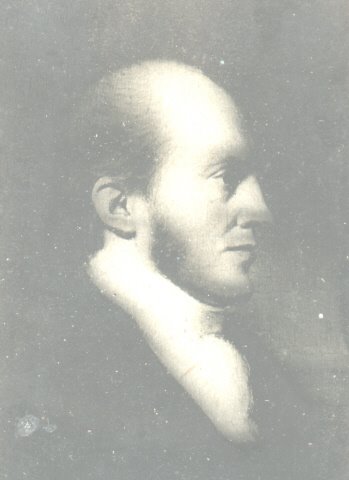
Also acquired for this collection and shown here, is an early photographic slide of the Vanderlyn portrait. This portrait was published by Yale University Press as part of its series "The Pageant of America".

This slide appears to show Burr with deep mutton-chop whiskers, which do not seem to feature so prominently in the other portraits. It may be shadow, or perhaps the photograph is of a modified version of the Vanderlyn portrait.

It seems that other miniature portraits copied from the engraving may exist, although to date only one has been found. This other miniature, as depicted here, shows Burr wearing a blue coat and can be seen at the New York Historical Society.

However, it appears the NYHS miniature of Burr was probably painted after 1900, as the frame looks modern and the blue pastel colour used for his jacket is a modern colour that was not used in the 19C.

This must also be a copy from an engraving, as a copy painted by an artist viewing the original portrait would have much more likely have shown him wearing the original black coat.

Just for comparative and reference purposes, a close up of the NYHS miniature is shown here, but for the proper reference to it, including a full picture of the frame, please refer to the official NYHS website which can be reached via the following link http://emuseum.nyhistory.org/code/emuseum.asp?style=browse¤trecord=1&quicksearch=aaron%20burr

For more about Aaron Burr, including current updates, see The Aaron Burr Association For another portrait and a photo of his grave, see http://www.findagrave.com/cgi-bin/fg.cgi?page=gr&GSln=burr&GSfn=aaron&GSbyrel=all&GSdyrel=all&GSob=n&GRid=151& 745